MYOPIA ACTION MONTH:
Empowering practices to take the next step in Myopia Management

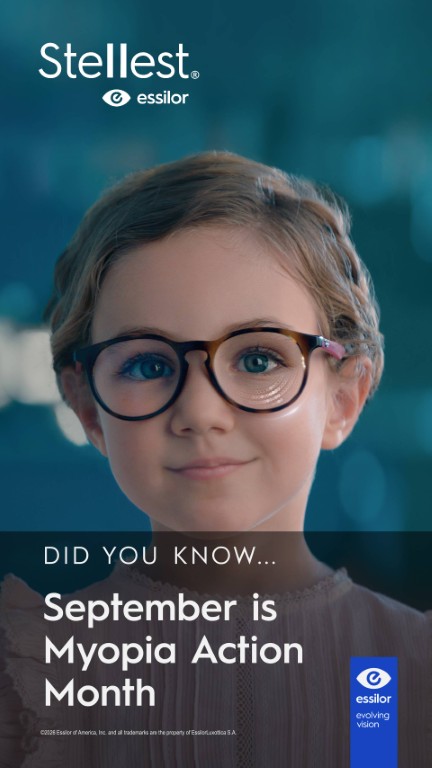
Myopia management has come a long way in recent years. As prevalence continues to rise,1,2 the conversation around childhood myopia has evolved from building awareness to helping practitioners and families understand what they can do about it. For eye care providers (ECPs), that means having the confidence and resources to recognize myopia, discuss its progression with parents and children, and consider appropriate management options.
Myopia Action Month (MAM) began with Myopia Awareness Week (MAW). While working at the Brien Holden Vision Institute in Australia, my colleagues and I asked what felt like a simple question: Why wasn’t there greater awareness of myopia and its real-world impact on children’s vision? We set out to establish a global awareness week, and over time, that movement grew alongside the science, advocacy and treatment options available to practitioners.
Several years later, while working with Myopia Profile, I found myself asking a different question: When does awareness turns into action? Despite years of research, education and advocacy, I was still seeing practitioners hesitate to take the first steps toward incorporating myopia management into their practices. That’s where Myopia Action Month came in. Working alongside practitioner and industry colleagues, we created Myopia Action Month to help ECPs move from knowing that myopia matters to feeling confident having the conversation with parents and children.
LEAD THE CHANGE
ECPs are uniquely positioned to lead that change. They are often the first and most accessible point of care for families, and they can identify changes in a child’s vision, educate parents and help guide them toward appropriate management. As myopia is increasingly recognized as a chronic, progressive condition,3,4 that role is becoming even more essential. The need is growing, too: U.S. myopia prevalence has increased from 25% to 42% over the past three decades,5 and globally, myopia is projected to affect 50% of the population by 2050.1
Momentum around myopia management has accelerated significantly since the introduction of Myopia Action Month. The FDA authorization of Essilor® Stellest® lenses marked an important shift for the U.S. market, making a proven myopia management solution more accessible to practitioners and families.4,6 For the first time, ECPs have an FDA-authorized spectacle lens option backed by clinical evidence to help address this growing need.4,6 In the latest 24-month U.S. randomized clinical trial published in JAMA Ophthalmology, highly aspherical lenslet (HAL) spectacle lenses slowed myopia progression by 71% and axial elongation by 53% compared with single-vision lenses in children ages 6 to 12.6 For practices that have been waiting for the right time to get started, that time is now. EssilorLuxottica is helping ECPs take that step with Essilor® Stellest® lenses, education, training and resources designed to build confidence and make myopia management part of everyday patient care.
Practices aren’t expected to build a myopia management program overnight. Training staff, developing an approach to conversation with parents, understanding treatment options and establishing a simple follow-up process can make it easier to get started. With support from organizations such as the Global Myopia Awareness Coalition (GMAC), along with education, training and practice-support resources from EssilorLuxottica, ECPs have access to the tools they need to build confidence and take those first steps.
The opportunity now is to build on the awareness we’ve created and turn it into action — one conversation, one child and one practice at a time.
RESOURCES
Resources to Help Your Practice Take Action
Explore the MAM education hub for tools designed to help ECPs start the conversation and build myopia management into practice:
- Myopia Action Month 2026 Product Guide
- Patient education materials and downloadable resources
- Myopia management treatment education and practice tools
- Essilor® Stellest® lens education and clinical resources
- The latest JAMA Ophthalmology research on the efficacy of HAL spectacle lenses
For additional resources to help train your team and prepare your practice for myopia management, please contact your EssilorLuxottica Account Executive.
DISCOVER STELLEST LENSES
FIND AN ESSILOR ACCOUNT EXECUTIVE
Enter your zip code to find an Essilor Account Executive near you.
References
1. Holden BA, Fricke TR, Wilson DA, et al. Global Prevalence of Myopia and High Myopia and Temporal Trends from 2000 through 2050. Ophthalmology. 2016;123(5):1036-1042. doi:10.1016/j.ophtha.2016.01.006
2. Liang J, Pu Y, Chen J, et al. Global prevalence, trend and projection of myopia in children and adolescents from 1990 to 2050: a comprehensive systematic review and meta-analysis. Br J Ophthalmol. 2025;109(3):362-371. Published 2025 Feb 24. doi:10.1136/bjo-2024-325427
3. National Academies of Sciences, Engineering, and Medicine. Myopia: Causes, Prevention, and Treatment of an Increasingly Common Disease. Washington, DC: The National Academies Press; 2024.
4. U.S. FDA. FDA authorizes marketing of first eyeglass lenses to slow progression of pediatric myopia. Sep 2025. https://www.fda.gov/news-events/press-announcements/fda-authorizes-marketing-first-eyeglass-lenses-slow-progression-pediatric-myopia
5. Vitale S, Sperduto RD, Ferris FL 3rd. Increased prevalence of myopia in the United States between 1971-1972 and 1999-2004. Arch Ophthalmol. 2009;127(12):1632-1639. doi:10.1001/archophthalmol.2009.303
6. Shen J, Hunt C, Young G, Drobe B. Spectacle Lenses With Highly Aspherical Lenslets for Myopia Control: A Randomized Clinical Trial. JAMA Ophthalmol. Published online August 20, 2026. doi:10.1001/jamaophthalmol.2026.3288|
7. Compared to single vision lenses. Results from a prospective, randomized, double-masked, multicenter U.S clinical trial in myopic children aged 6-12 years at initiation of treatment.
8. Essilor Internal, data on file (2005)